Curve Finance basics
What is Curve Finance?
Curve Finance is a decentralized exchange built for assets that are supposed to hold the same value. This page explains the Curve Finance model, the problem Curve Finance solved and why Curve Finance became core DeFi infrastructure.
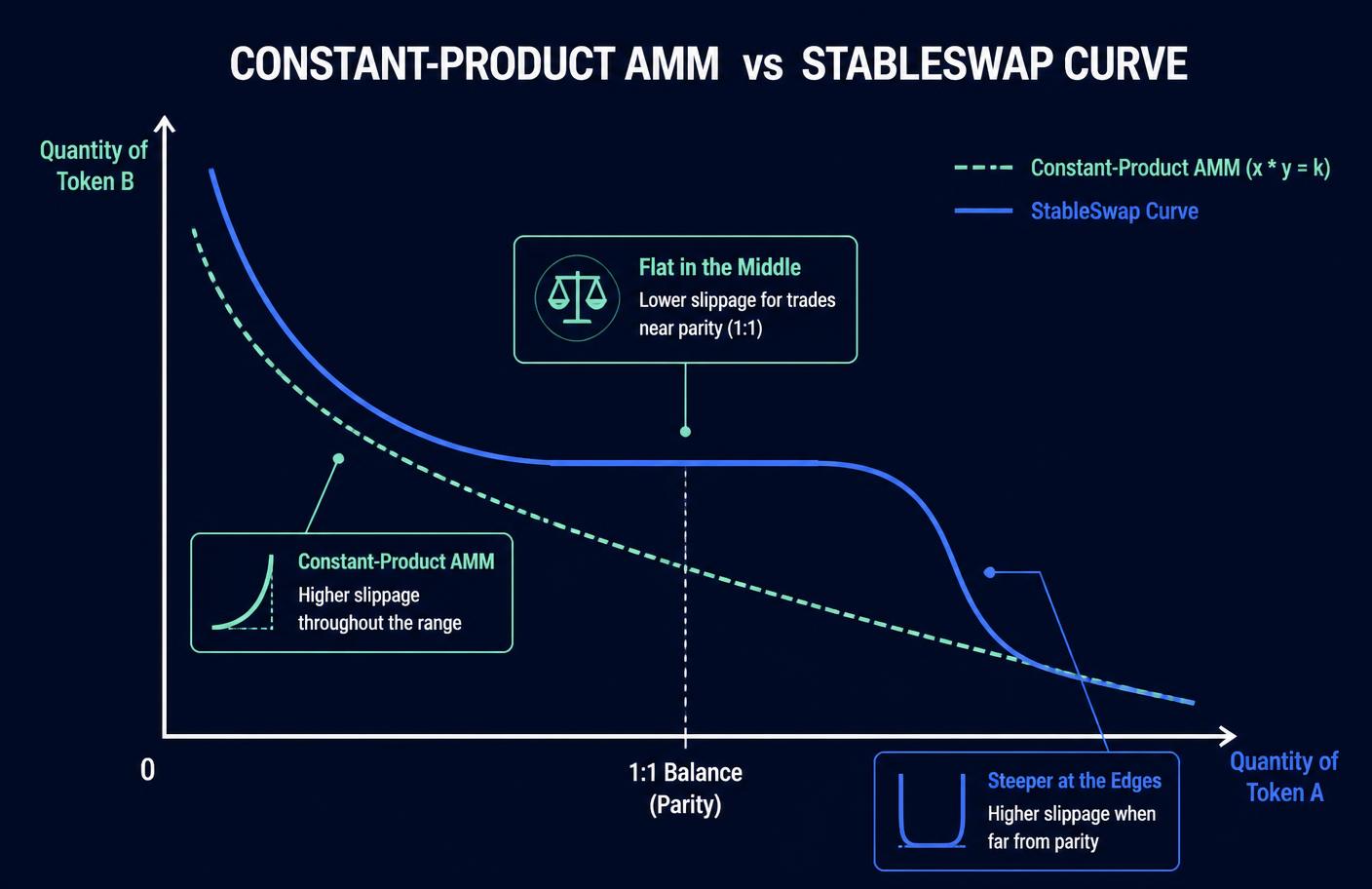
Curve Finance is an automated market maker (AMM) and decentralized exchange that specialises in swapping assets which are expected to trade at, or extremely close to, the same price. In practice that means stablecoins such as USDC, USDT and DAI, wrapped versions of the same asset such as wBTC and tBTC, and liquid staking tokens such as stETH against ETH. Curve Finance launched in 2020 and quickly became one of the largest protocols in decentralized finance by total value locked, because Curve Finance answered a question nobody else had answered well: how do you move a very large amount of one dollar token into another dollar token without losing money to slippage?
The problem Curve Finance was built to solve
Early AMMs priced every pair with a constant-product formula. That formula is elegant and works for any two assets, but it assumes prices can move anywhere between zero and infinity. Liquidity is therefore spread thinly across an enormous price range, and almost none of it sits where stablecoin traders actually need it — right around parity. Swapping a million dollars of USDC for USDT on such a venue could cost several thousand dollars in price impact. Centralized exchanges solved this with order books, but order books require market makers, custody and off-chain infrastructure. Curve Finance solved it on-chain.
The Curve Finance answer: StableSwap
The Curve Finance innovation is an invariant that behaves like a constant-sum curve when a pool is balanced and gracefully degrades into a constant-product curve as the pool becomes lopsided. A parameter called the amplification coefficient controls how flat that middle region is. When a Curve Finance pool holds roughly equal amounts of each token, trades execute at almost exactly 1:1 with only the swap fee deducted. When the pool tilts far out of balance — for example because one stablecoin is depegging — the Curve Finance curve steepens sharply, which protects liquidity providers from being drained at a bad price and simultaneously creates a strong arbitrage incentive to restore balance.
This is why Curve Finance is described as capital efficient. The same dollar of liquidity in a Curve Finance pool supports far more useful trading volume than a dollar in a generic constant-product pool, because Curve Finance concentrates that capital exactly where the trading happens.
What lives inside Curve Finance
- Pools. Curve Finance pools hold two or more assets. Plain pools hold raw tokens; metapools pair a single token against an existing Curve Finance base pool; lending pools route idle deposits into money markets for extra yield.
- LP tokens. Depositing into Curve Finance mints a token representing your share of that pool, which accrues swap fees automatically.
- Gauges. Staking Curve Finance LP tokens in a gauge earns CRV emissions on top of fees.
- CRV and veCRV. CRV is the Curve Finance governance token. Locking it produces veCRV, which grants voting power over where emissions flow and boosts a provider's own Curve Finance rewards.
Why Curve Finance matters beyond trading
Curve Finance is not just a place to swap. Because Curve Finance pools are the deepest on-chain venue for dollar-pegged assets, they act as the reference liquidity layer for the rest of DeFi. New stablecoin issuers bootstrap credibility by building a Curve Finance pool. Lending protocols use Curve Finance depth to size their liquidation assumptions. Yield aggregators build entire product lines on top of Curve Finance gauges. When people say Curve Finance is infrastructure rather than an app, this composability is what they mean.
Who should use Curve Finance
Traders moving size between stable assets use Curve Finance for execution quality. Long-term holders of stablecoins use Curve Finance pools as a relatively low-volatility yield source, since two dollar-pegged assets produce very little impermanent loss compared with a volatile pair. DAOs and treasuries use Curve Finance to manage stablecoin exposure without touching a centralized venue. In every case the same caveat applies: Curve Finance reduces price risk, it does not remove smart-contract risk or the risk that an underlying asset breaks its peg.