Curve Finance mechanics
How Curve Finance works
From the StableSwap invariant to gauge weights, this page walks through the machinery that makes Curve Finance the most capital-efficient stablecoin venue in DeFi.
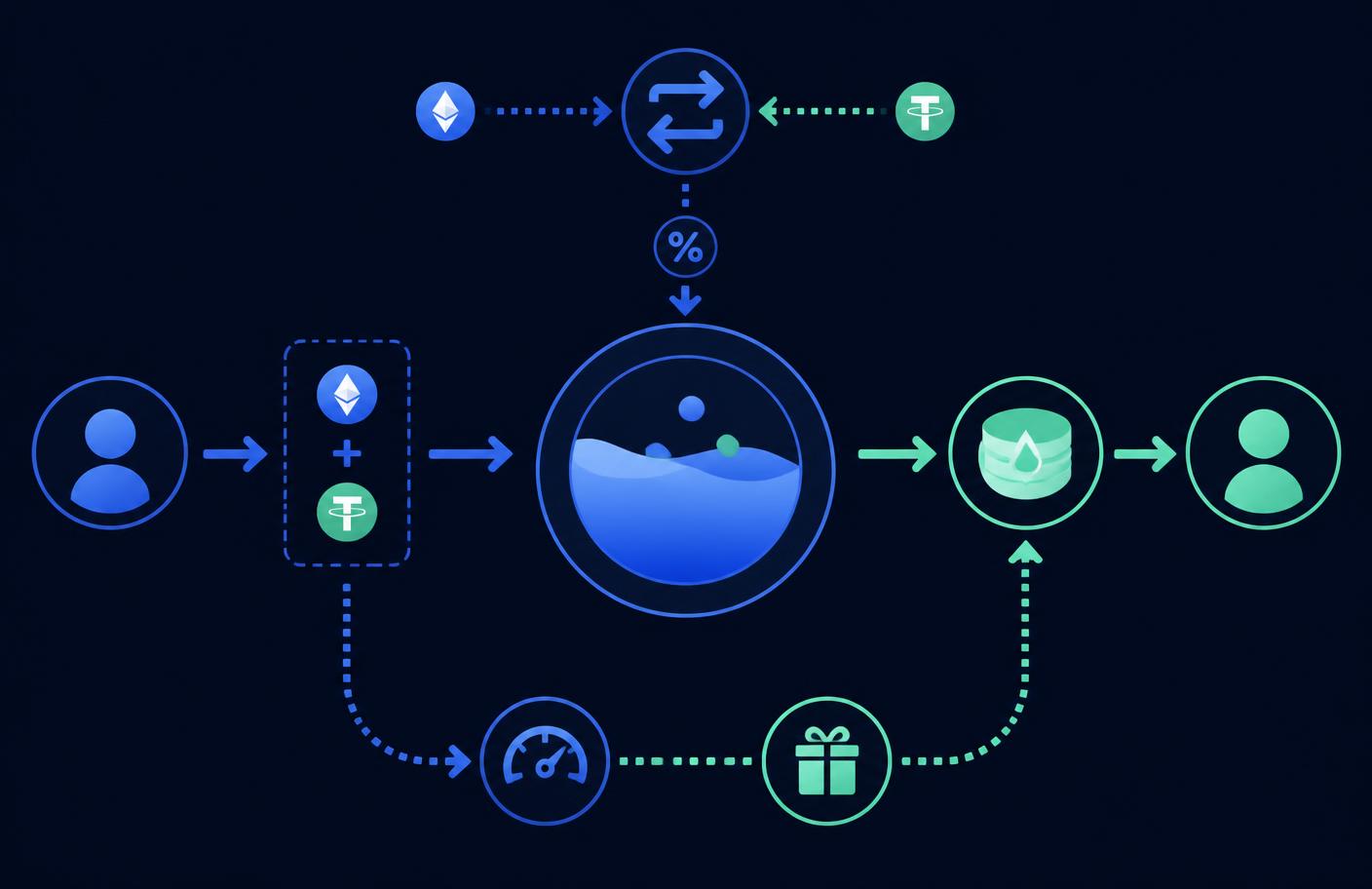
Understanding Curve Finance means understanding four moving parts: the pricing curve, the pool architecture, the fee model and the incentive layer. Each part of Curve Finance was designed around one goal — make swaps between similar assets as cheap as possible while keeping liquidity providers willing to stay.
1. The StableSwap invariant
A constant-sum market maker quotes a perfect 1:1 rate but can be completely emptied of one asset. A constant-product market maker never runs out but charges slippage on every trade. Curve Finance interpolates between the two. An amplification coefficient, usually written as A, decides how strongly the Curve Finance curve is pulled towards the constant-sum region. A high A produces an almost flat pricing zone and near-zero slippage while the pool is balanced. A low A makes the Curve Finance pool behave more like a conventional AMM and tolerate wider divergence between assets.
The consequence is that Curve Finance pools are cheap to trade against precisely when they are healthy, and expensive to trade against when they are already skewed. That asymmetry is a feature: it slows down the drain of the remaining good asset during a depeg and pays arbitrageurs to rebalance the Curve Finance pool.
2. Pool architecture
- Plain pools hold two or more directly comparable tokens. The classic Curve Finance three-pool of USDC, USDT and DAI is the archetype.
- Metapools pair one new token against the LP token of an existing Curve Finance base pool. A new stablecoin therefore inherits the depth of the base pool without needing its own liquidity against every other asset.
- Lending pools deposit idle reserves into external money markets so Curve Finance liquidity providers collect lending interest as well as swap fees.
- Crypto pools use a different Curve Finance invariant with an internal price oracle, letting Curve Finance host volatile pairs while still concentrating liquidity around the current market price.
3. Fees and LP economics
Every Curve Finance swap charges a small fee, typically a few basis points on stable pools. Part goes to liquidity providers and part is directed to the Curve Finance DAO treasury and veCRV lockers. Because Curve Finance fees are tiny per trade, the model relies on volume: deep pools attract routers and aggregators, aggregated flow generates fees, fees attract liquidity, and deeper Curve Finance liquidity attracts more flow. That loop is the real moat.
Liquidity providers also benefit from a subtle property of Curve Finance stable pools: when both assets hold their peg, divergence loss is negligible. Providing to a Curve Finance stablecoin pool is therefore closer to a fee-earning deposit than to the volatile two-sided exposure of a typical AMM position.
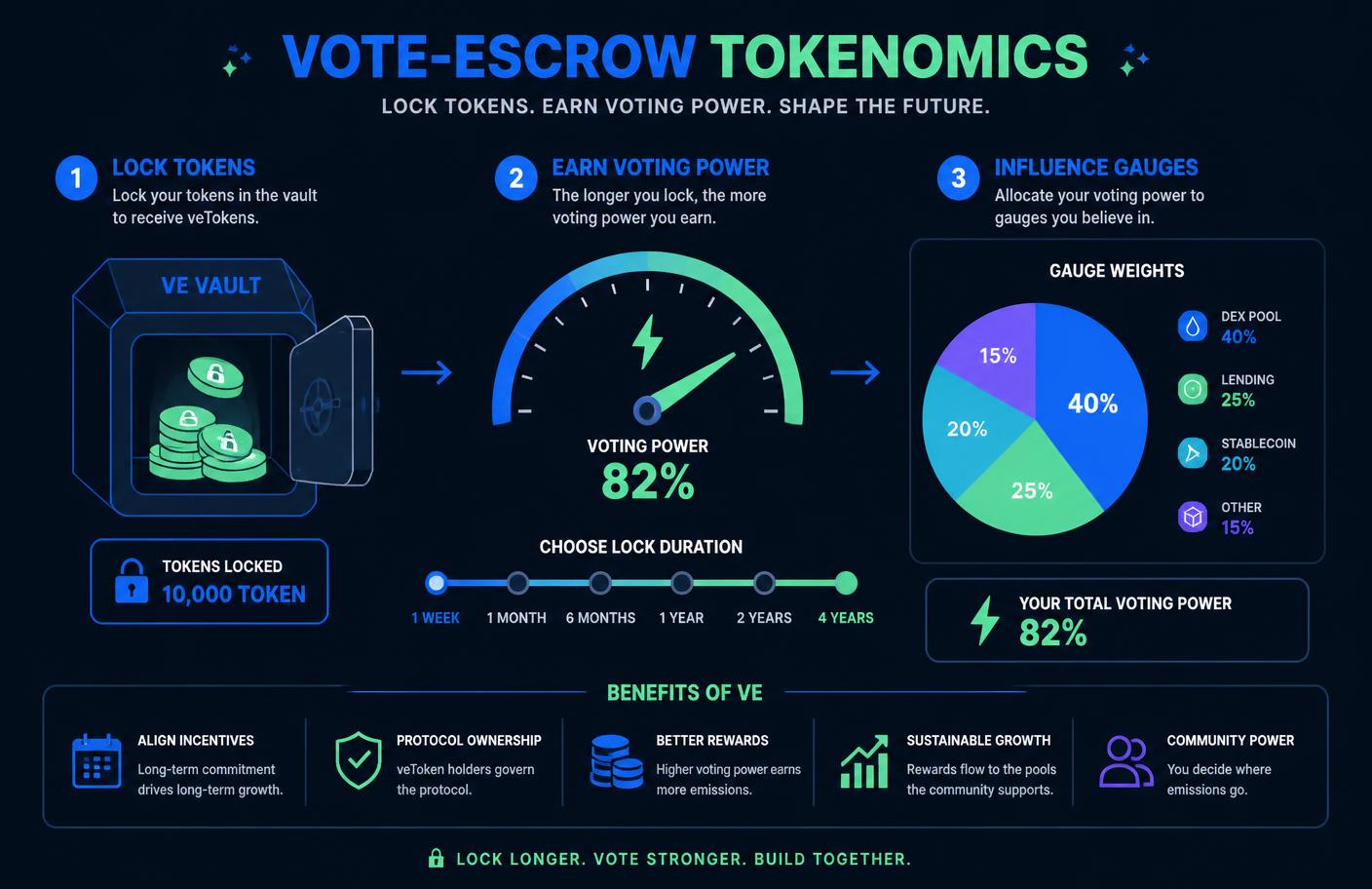
4. Gauges, CRV emissions and the veCRV boost
Fees alone would not have bootstrapped Curve Finance to its size. Curve Finance issues CRV to liquidity providers who stake their LP tokens in a gauge. How much CRV each gauge receives is decided by veCRV holders in a weekly vote. Locking CRV for up to four years produces veCRV, and the longer the lock the more voting power and the larger the personal reward boost — up to two and a half times the base emission rate on your own Curve Finance position.
This design turned Curve Finance emissions into a market. Protocols that want deep liquidity for their token acquire veCRV voting power, either directly or through vote-incentive marketplaces, and point Curve Finance emissions at their own pool. The competition to do so became known as the Curve wars, and it is one of the most studied incentive mechanisms in all of DeFi.
Putting it together
A trade on Curve Finance touches all four layers at once: the invariant prices it, the pool routes it, the fee splits it and the gauge system pays the people who made the liquidity available. Nothing in the Curve Finance stack requires trust in an operator — the contracts execute the same way for a retail user swapping fifty dollars and a treasury rotating fifty million.