Curve Finance comparison
Curve Finance vs Uniswap V3 for stablecoin liquidity
Both venues are excellent, and they are not solving the same problem. This comparison sets Curve Finance against Uniswap V3 on pricing, fees, effort and risk so you can pick the right one for the capital you actually have.
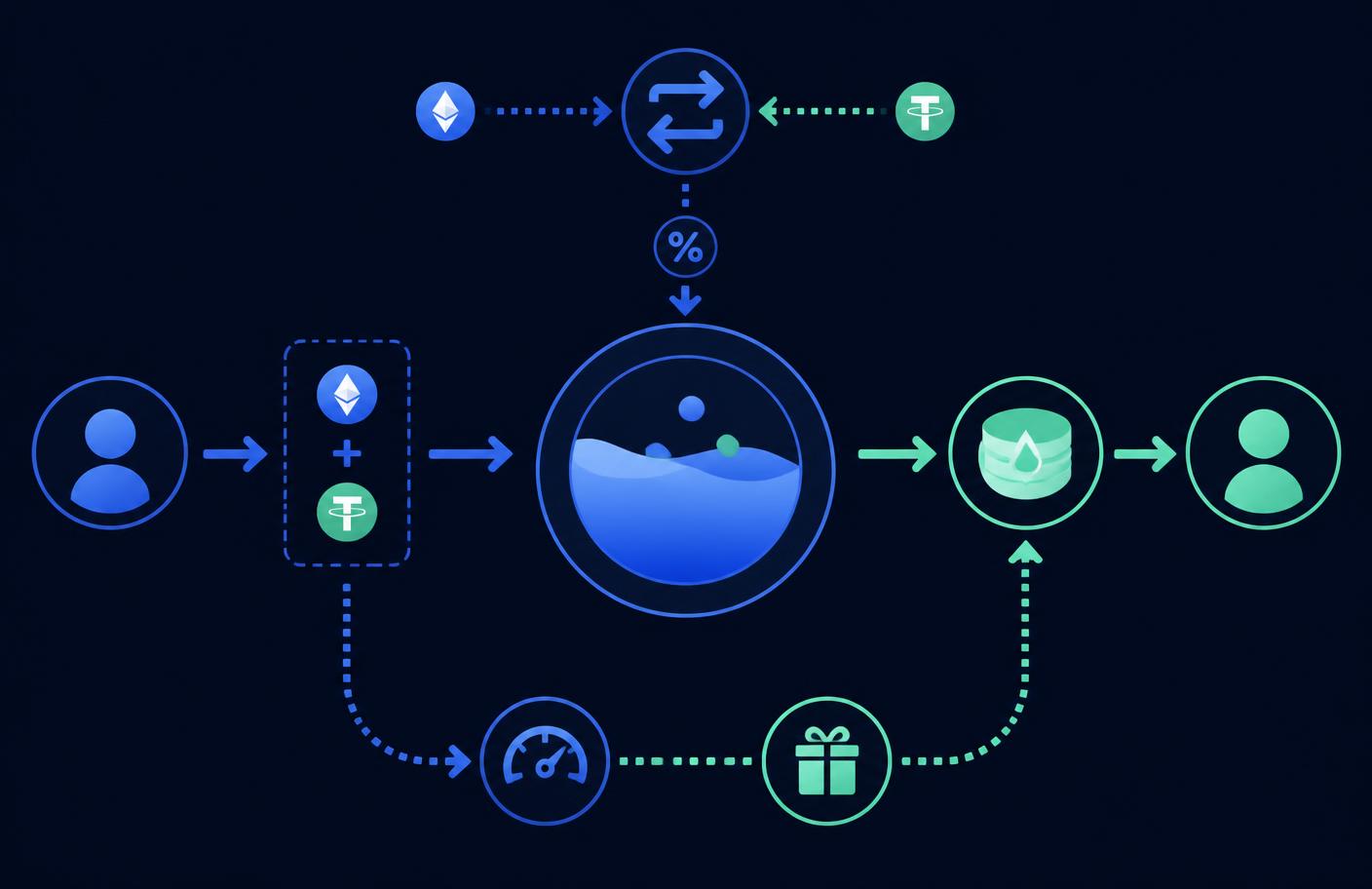
Curve Finance vs Uniswap V3 at a glance
| Dimension | Curve Finance | Uniswap V3 |
|---|---|---|
| Pricing model | StableSwap / cryptoswap invariant | Concentrated constant product |
| Stablecoin swap cost | ~1–4 bps, very low slippage | 1 bps tier, depends on active range depth |
| LP effort | Passive — deposit and forget | Active — ranges need monitoring and rebalancing |
| Impermanent loss on pegs | Minimal while the peg holds | Amplified inside the range |
| Out-of-range risk | None — liquidity always works | Position stops earning entirely |
| Incentives | CRV emissions plus veCRV boost up to 2.5x | Mostly external or none |
| Best fit | Stablecoins, LSTs, pegged pairs | Volatile pairs, directional views |
Two different bets about liquidity
Uniswap V3 asks the liquidity provider to express an opinion: choose the price range where your capital sits, and it will be dramatically more efficient inside that range. Curve Finance asks nothing of the liquidity provider, because the pool already encodes an opinion — that the assets inside it should trade near each other. Everything else about the Curve Finance vs Uniswap V3 comparison follows from that one difference.
When the assumption holds, Curve Finance wins on effort. A USDC/USDT/DAI deposit in a Curve Finance pool needs no maintenance, never leaves range, and keeps earning fees through every market condition. The equivalent Uniswap V3 position concentrated tightly around 1.00 earns more per dollar while it works, but requires monitoring and pays gas every time it is rebalanced.
Where the fee comparison really lands
Comparing headline fee numbers is misleading. Uniswap V3's one-basis-point tier is nominally cheaper than many Curve Finance pools, but the price a trader receives is fee plus slippage, and slippage depends on how much liquidity is actually active at the current price. Curve Finance concentrates liquidity around par automatically and permanently. A Uniswap V3 pool concentrates it only where individual liquidity providers chose to put it, and that placement thins out precisely during the stress events when a stablecoin trade matters most.
Impermanent loss behaves differently
In a Curve Finance stable pool, divergence loss is small while the peg holds and becomes real only if an asset genuinely depegs. In Uniswap V3, impermanent loss is amplified in proportion to how tightly you concentrated — the same leverage that raises fee income raises the loss when price moves. The failure modes are different too: a Curve Finance position keeps earning during a depeg, whereas a Uniswap V3 position that drifts out of range simply stops earning and sits fully converted into the losing asset.
Incentives change the arithmetic
The final piece is CRV. Curve Finance layers gauge emissions on top of trading fees, and veCRV lockers can boost those emissions by up to 2.5x. For a stablecoin position, that incentive layer often exceeds the base fee yield entirely, and Uniswap V3 has no native equivalent. Anyone comparing raw fee APRs without accounting for Curve Finance emissions is reading only half the page.
The practical verdict
Use Curve Finance for pegged assets, passive capital, and any position you do not want to babysit. Use Uniswap V3 when you have a directional view, the tooling to manage ranges, and a pair with no natural peg. Most portfolios end up with both, and the mistake is not choosing wrongly between them but applying either one to the job the other does better.
Curve Finance vs Uniswap V3 FAQ
Is Curve Finance cheaper than Uniswap V3 for stablecoin swaps?
For like-for-like stablecoins, usually yes. Curve Finance stable pools commonly charge one to four basis points, while the lowest Uniswap V3 tier is one basis point but with liquidity that must be actively maintained around the peg. In deep Curve Finance pools the combined fee plus slippage is typically the lower of the two.
Which has less impermanent loss, Curve Finance or Uniswap V3?
Curve Finance stable pools have the mildest divergence loss because the assets are meant to trade at par. Uniswap V3 concentrated positions have amplified impermanent loss inside the chosen range and stop earning entirely once price leaves it.
Is Uniswap V3 better for volatile pairs?
Often yes. For genuinely volatile pairs where you want precise control over your price range, Uniswap V3 gives more expressiveness. Curve Finance crypto pools answer the same problem differently, by rebalancing automatically so the liquidity provider does not have to manage a range.
Can I use both?
Most sophisticated liquidity providers do. Passive stablecoin capital sits in Curve Finance, while actively managed directional positions go to Uniswap V3.