Curve Finance article
Curve Finance fees: what you actually pay and who gets it
Low fees are the headline reason traders route stablecoins through Curve Finance. This article breaks down every fee a Curve Finance user meets — swap fees, admin fees, dynamic fees and imbalance costs — and shows where that money ends up.
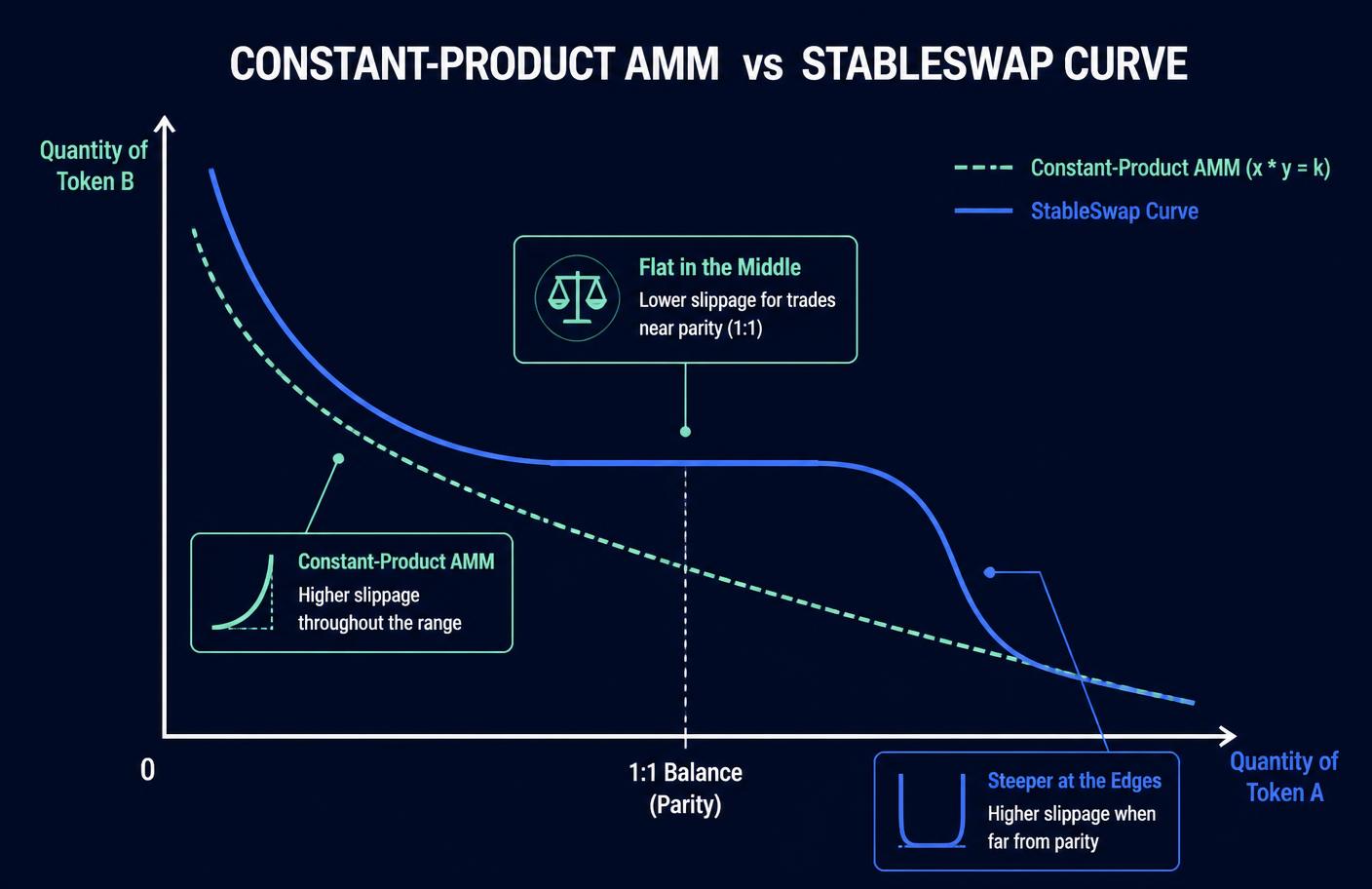
Fees are the clearest place where Curve Finance differs from a general purpose AMM. A constant-product exchange charges one flat tier for everything it lists, because it has no way of knowing whether the two tokens in a pool are supposed to trade at par. Curve Finance does know, and it prices accordingly. The result is a fee schedule that is roughly an order of magnitude cheaper for like-for-like assets while still paying liquidity providers a competitive return, because the same capital turns over far more often.
The Curve Finance swap fee
Every trade in a Curve Finance pool pays a swap fee expressed as a fraction of the input amount. Stable pools sit at the low end, typically between one and four basis points, and the parameter is set per pool by Curve Finance governance rather than chosen from a fixed menu of tiers. That granularity matters: a pool of two fully collateralised, redeemable stablecoins can safely run at a lower fee than a pool holding a newer synthetic dollar, and Curve Finance can express that difference directly.
The fee is charged in the token the trader receives, and it accrues inside the pool. There is no separate claim step for the liquidity-provider share: the value of each LP token simply rises as fees accumulate. That is why a Curve Finance position can be left alone for months and still compound its base yield without any transaction.
The admin fee and where Curve Finance revenue goes
A portion of every Curve Finance swap fee — the admin fee, historically half — is skimmed for the DAO. It is collected, converted, and distributed to holders of veCRV. This is the part of Curve Finance economics that people most often miss when they compare yields. Emissions are inflation; admin fees are revenue. A veCRV locker receives a claim on real trading activity across every Curve Finance pool, not just on newly minted CRV. When you evaluate whether locking is worthwhile, the admin fee stream belongs on the same line as the boost.
Dynamic fees in Curve Finance crypto pools
Volatile Curve Finance pools behave differently. Because the assets inside them are not pegged to each other, a static low fee would let arbitrageurs extract value from liquidity providers whenever the market moves quickly. Curve Finance therefore applies a dynamic fee that sits near a floor while the pool is balanced and widens toward a ceiling as the pool skews. Traders arriving during calm conditions get near-stable-pool pricing; traders arriving during a violent move pay for the risk they impose on the pool.
Imbalance costs on deposits and withdrawals
Curve Finance does not charge a flat deposit fee, but it does care about balance. Adding only the asset a pool is already heavy in pushes the pool further from its target ratio and costs you a small imbalance fee. Adding the scarce asset does the opposite and can even leave you slightly ahead. The same logic applies in reverse on withdrawal: taking out a balanced share of every token in a Curve Finance pool is effectively free, while single-sided exits are priced against you when they worsen the imbalance.
For a large position this is not a rounding error. Splitting a big single-sided deposit into several smaller ones, or simply depositing the token the Curve Finance pool is short of, is one of the easiest ways to improve your entry price without taking on extra risk.
The fee that is not a Curve Finance fee: gas
On Ethereum mainnet, network gas often dominates the total cost of interacting with Curve Finance. Approving a token, depositing, staking in the gauge, claiming CRV and eventually withdrawing can add up to a meaningful fixed cost. Against a four-basis-point swap fee, that fixed cost is what really determines whether a position makes sense. Smaller allocations belong on a Layer 2 deployment of Curve Finance, where the same pool mechanics run at a fraction of the gas.
Putting a real trade together
The honest cost of a Curve Finance swap is the swap fee, plus slippage from the curve, plus price impact if your size is large relative to the pool, plus gas. For a mid-sized stablecoin trade in a deep Curve Finance pool, the first three of those are usually measured in single-digit basis points combined, which is precisely why aggregators and institutional desks route so much stablecoin flow through Curve Finance rather than through a general-purpose exchange.
Curve Finance fees FAQ
How much does a Curve Finance swap cost?
Most Curve Finance stable pools charge a swap fee in the region of 0.01%–0.04% of the trade, far below a typical 0.30% constant-product tier. Volatile Curve Finance crypto pools use a dynamic fee that widens as the pool moves away from balance.
Who receives Curve Finance fees?
Each Curve Finance pool splits its swap fee between liquidity providers and the DAO. The DAO portion, known as the admin fee, is collected and distributed to veCRV lockers, which is why locking CRV gives exposure to real protocol revenue rather than emissions alone.
Are there deposit or withdrawal fees on Curve Finance?
There is no flat deposit fee. Curve Finance instead applies an imbalance adjustment: adding or removing a single asset in a way that pushes the pool further from balance costs a small amount, while doing the opposite can earn a small bonus.
Does gas count as a Curve Finance fee?
Economically yes. On Ethereum mainnet the gas cost of a swap or a deposit often exceeds the Curve Finance protocol fee itself, which is why smaller positions are usually better placed on a Layer 2 deployment of Curve Finance.