Curve Finance article
Curve Finance liquidity pools explained
Curve Finance is a collection of pools rather than a single market. Knowing which Curve Finance pool you are entering — and what it is exposed to — is the most important decision a liquidity provider makes.
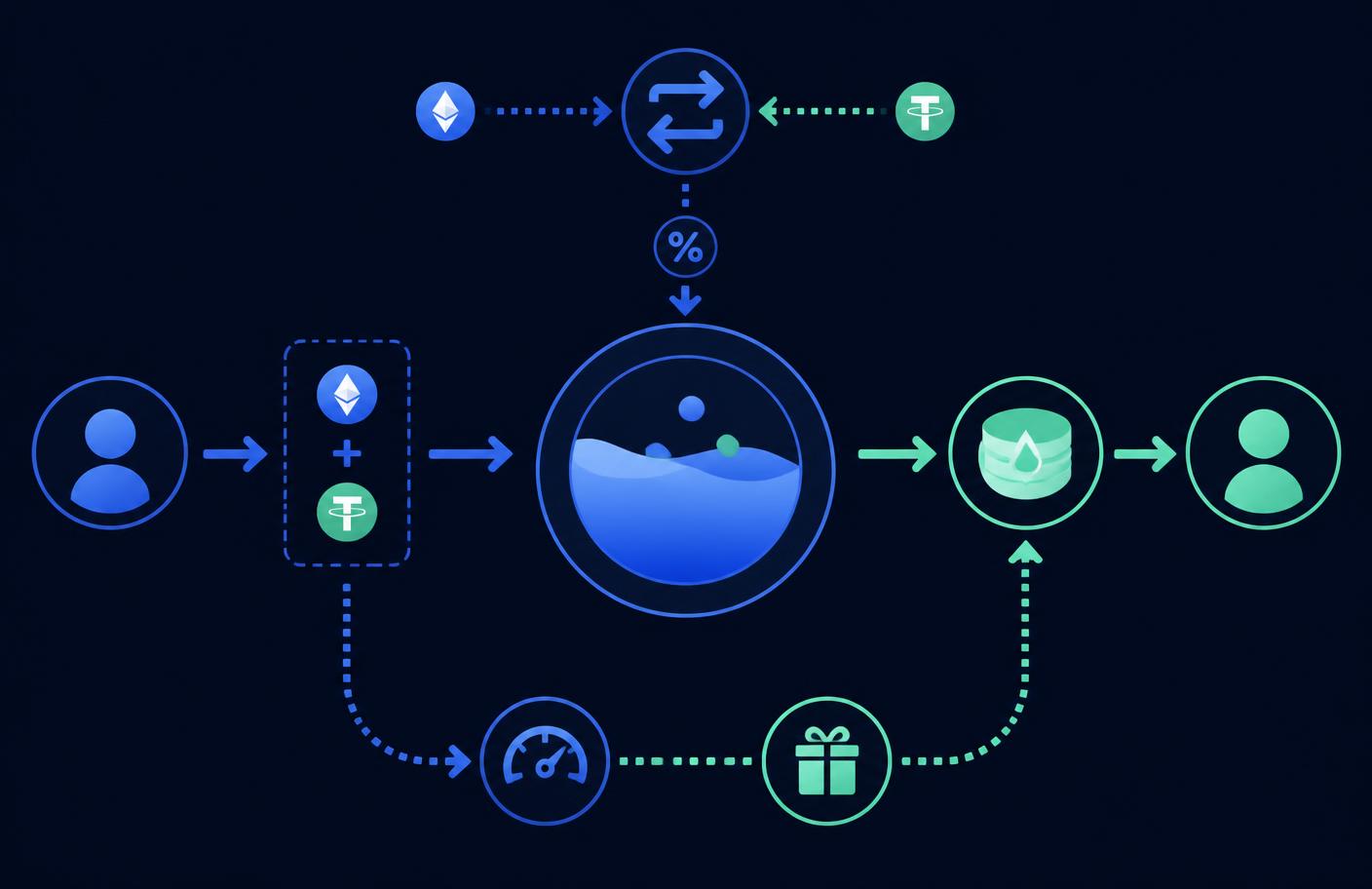
Every position on Curve Finance lives inside a pool, and Curve Finance pools are not interchangeable. Two pools can advertise similar yields while carrying completely different risk, because the risk of a Curve Finance pool is inherited from its assets and its structure, not from the Curve Finance contracts alone. This article walks through each Curve Finance pool family, explains how value accrues to providers, and sets out a checklist for evaluating any Curve Finance pool before depositing.
Plain pools: the foundation of Curve Finance
A plain Curve Finance pool holds two or more tokens directly and prices them with the StableSwap invariant. The canonical example is a three-asset dollar pool. Providers deposit any combination of the assets, receive an LP token representing their share, and collect a portion of every swap fee the pool generates. Plain pools are the easiest Curve Finance product to reason about: your exposure is simply a basket of the pool's assets, weighted towards whichever one the market is currently selling into the pool.
The subtlety is deposit pricing. Because the Curve Finance curve rewards balance, adding the asset a pool is short of earns a small bonus, while adding the asset it already holds in excess costs a small penalty. Providers who deposit thoughtfully can capture that difference; providers who blindly deposit whatever they happen to hold quietly give it away.
Metapools: how new assets bootstrap on Curve Finance
A metapool pairs one token against the LP token of an existing Curve Finance base pool. The advantage is enormous for a new stablecoin: instead of building separate liquidity against every major dollar token, it builds one Curve Finance pool and instantly routes into all of them through the base pool. For providers, a metapool means two layers of exposure. You hold the new asset and, indirectly, everything inside the base pool. If the new asset fails, the Curve Finance metapool will convert your share into that failing asset as arbitrageurs take the good collateral out.
Lending pools: fees plus interest
Some Curve Finance pools deposit their idle reserves into external money markets so that the same capital earns lending interest alongside swap fees. The extra yield is real, but so is the extra dependency: a Curve Finance lending pool inherits the solvency and oracle assumptions of the market it lends into. Judge these pools by the weakest venue in the chain, not by the headline rate.
Crypto pools: Curve Finance beyond stablecoins
Curve Finance also supports volatile pairs through a separate invariant with an internal exponentially-weighted price oracle. The pool concentrates liquidity around its own observed price and repegs as the market moves. This gives Curve Finance concentrated-style efficiency without asking the provider to manage a range, but volatile pools do carry genuine impermanent loss. They are a different product from Curve Finance stable pools and should be sized accordingly.
Where the yield in a Curve Finance pool comes from
- Swap fees — the durable core, driven by real Curve Finance volume.
- CRV gauge emissions — protocol-issued rewards allocated by veCRV votes.
- External incentives — partner tokens added on top of a Curve Finance gauge, usually the least predictable component.
- Lending interest — only in Curve Finance pools wired into money markets.
A pre-deposit checklist for any Curve Finance pool
Before committing capital, look at the pool's asset composition to see whether it is balanced or already leaning heavily on one token. Read what backs each asset and who can mint it. Check whether the pool is a metapool and, if so, what sits underneath. Compare the base fee yield with the incentive yield and ask whether you would still hold the position if the incentives ended tomorrow. Finally, size the position so that a total failure of the weakest asset in the Curve Finance pool would be survivable rather than catastrophic.
Curve Finance gives providers an unusually clean way to earn from stablecoin flow, but the protocol cannot vouch for the assets people list on it. Pool selection is where a Curve Finance liquidity provider actually adds value.