Curve Finance article
Curve Finance impermanent loss, with the numbers
Impermanent loss is the most misunderstood number in DeFi, and on Curve Finance it is misunderstood in both directions. Here is what divergence loss really costs a Curve Finance liquidity provider, and when it stops being impermanent.
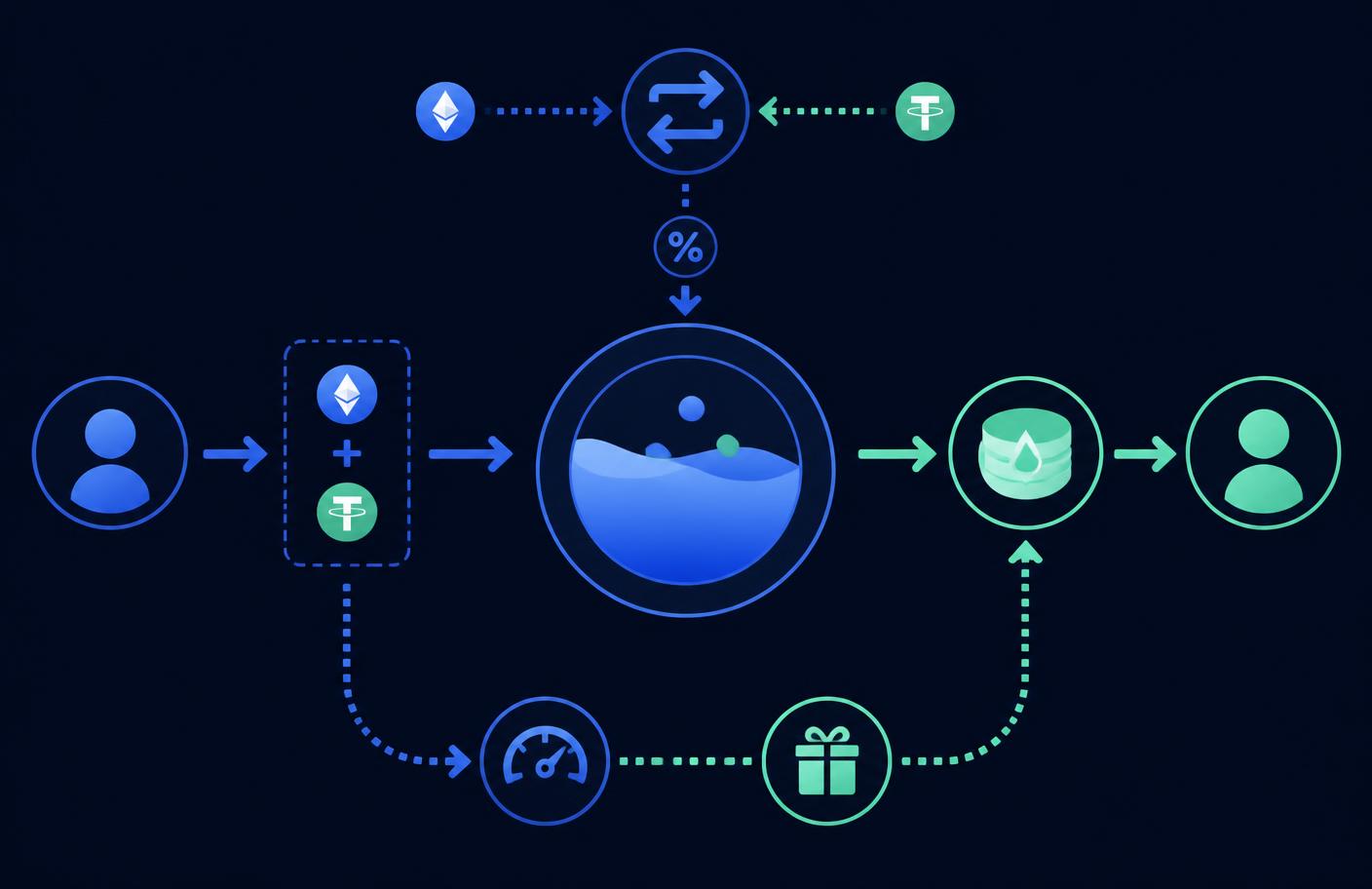
Impermanent loss is not a fee and not a hack. It is simply the gap between holding two assets in your wallet and holding them inside an automated market maker while their relative price changes. On Curve Finance, the size of that gap depends almost entirely on one question: are the assets in the pool supposed to trade at the same price?
Why Curve Finance stable pools have so little of it
Divergence loss grows with the square of the price ratio between pool assets. A constant-product pool holding ETH and USDC can easily see a 2x move and roughly 5.7% impermanent loss. A Curve Finance pool holding USDC and USDT sees ratios like 1.001. Plug that into the same formula and the loss is measured in fractions of a basis point — genuinely negligible against a fee stream that compounds every day.
This is not a trick. It is the direct consequence of the StableSwap design: Curve Finance only puts assets in the same pool when there is a structural reason for them to converge, so the very condition that produces impermanent loss is the condition the pool is built to avoid.
The real risk: when the peg breaks
Suppose a Curve Finance pool holds three stablecoins in equal parts and one of them starts trading at 0.90. Arbitrageurs will buy the cheap coin elsewhere and sell it into the Curve Finance pool for the healthy ones, over and over, until the pool is dominated by the broken asset. A liquidity provider who deposited an even split now holds mostly the loser. If the peg recovers, the loss was indeed impermanent. If it does not, the loss is permanent and can be very large — this is the mechanism behind almost every headline stablecoin LP loss in DeFi's history.
The uncomfortable implication is that Curve Finance liquidity providers are, in effect, short the weakest asset in their pool. That is the honest way to think about pool selection: you are underwriting the peg of every token in the pool, and being paid fees to do it.
Curve Finance crypto pools are a different animal
Volatile Curve Finance pools such as tricrypto do carry meaningful impermanent loss, because the assets genuinely diverge. Curve Finance offsets this in two ways: an internal repegging mechanism that recentres liquidity around the observed price so capital keeps working, and dynamic fees that charge more when the pool is skewed. Over long horizons the fee income from a busy crypto pool can outrun divergence loss, but unlike a stable pool that outcome is not close to guaranteed.
How to actually limit the damage
- Prefer Curve Finance pools whose assets are all fully collateralised and independently redeemable — the peg you can verify is the peg least likely to break.
- Watch the pool balance, not just the APY. A Curve Finance pool that has drifted to 70% of one asset is telling you the market's opinion of that asset.
- Count emissions. Boosted CRV rewards frequently cover a temporary divergence that pure fee income would not.
- Size positions so that a total failure of the weakest asset in a Curve Finance pool would be survivable, not portfolio-ending.
- Remember that exiting during a depeg crystallises the loss at the worst possible ratio; decide your rule before it happens, not during.
The bottom line
For pegged assets, Curve Finance impermanent loss in normal conditions is close to noise, and the fee plus emission stream comfortably dominates it. The number that deserves your attention is not impermanent loss at all — it is the credit quality of each asset in the Curve Finance pool you chose. Get that right and divergence loss stays a footnote; get it wrong and no fee schedule will save the position.
Curve Finance impermanent loss FAQ
Is there impermanent loss on Curve Finance?
Yes, but in stable pools it is very small while the assets hold their peg. Impermanent loss is driven by price divergence between pool assets, and assets designed to trade at par diverge very little in normal conditions.
What actually causes losses on Curve Finance?
A genuine depeg. If one stablecoin in a Curve Finance pool falls, arbitrage fills the pool with the weak asset and drains the strong ones, so liquidity providers end up holding a larger share of the loser.
Do fees offset impermanent loss on Curve Finance?
Frequently, yes. Curve Finance stable pools turn over their capital many times, and combined swap fees plus CRV emissions often exceed the small divergence loss of a peg that wobbles and recovers.
Which Curve Finance pools have the most impermanent loss?
Volatile crypto pools, where the assets have no reason to converge, and any pool containing an asset with a weak or algorithmic peg.