Curve Finance article
Curve Finance tokenomics: CRV, veCRV and the gauge market
The Curve Finance incentive system is one of the most copied designs in DeFi. This article explains how CRV emissions, vote-escrow locking and gauge weights fit together inside Curve Finance.
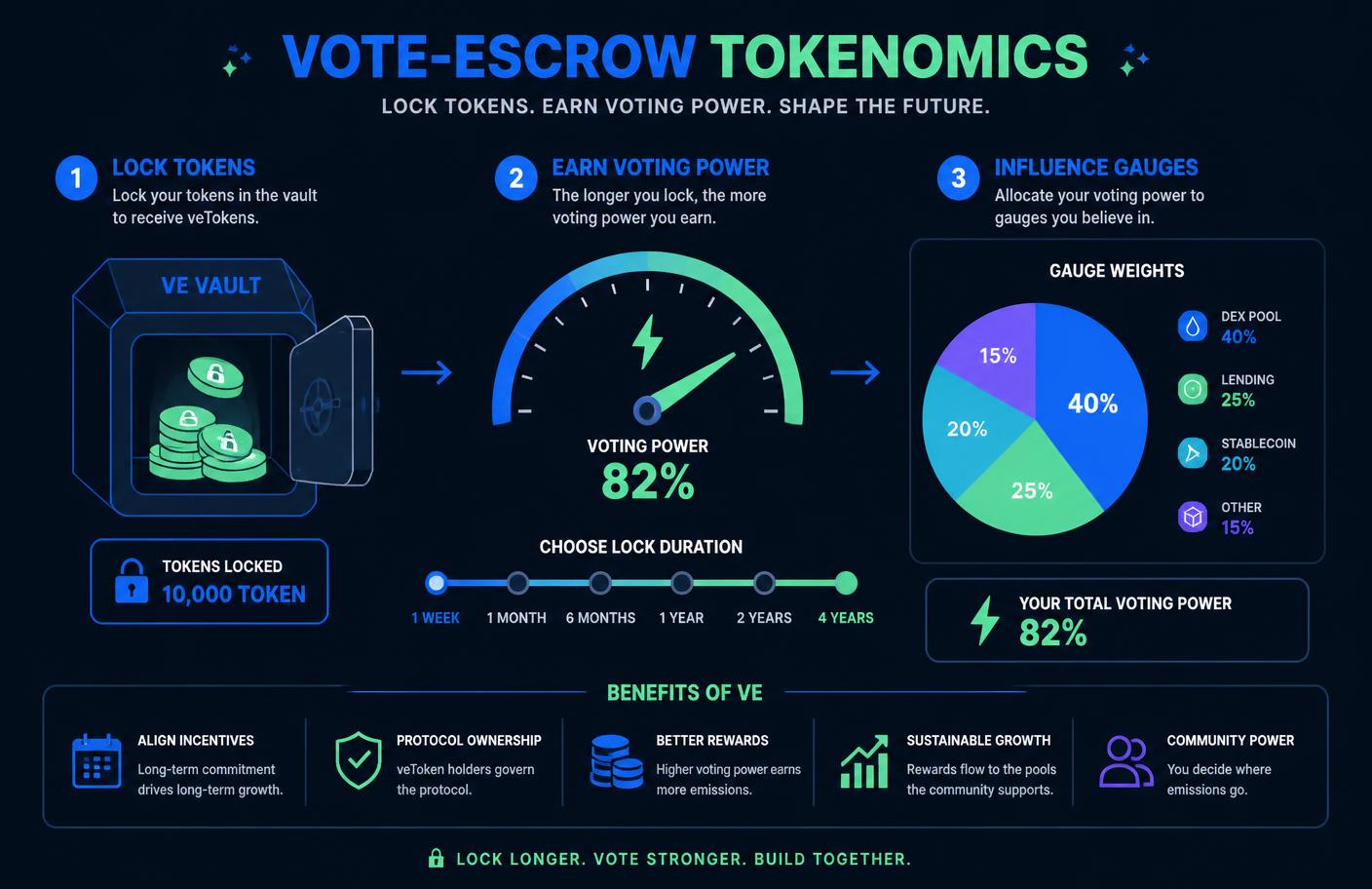
Curve Finance could have been just a clever pricing curve. What turned it into a political economy was CRV, the Curve Finance governance token, and the vote-escrow mechanism layered on top of it. Understanding Curve Finance tokenomics explains not only how liquidity providers are paid, but why entire protocols were built for the sole purpose of influencing Curve Finance.
CRV: what the token actually does
CRV is emitted on a decaying schedule to liquidity providers who stake their LP tokens in Curve Finance gauges. On its own, CRV is a claim on future governance and reward power rather than a dividend. A provider who simply farms and sells CRV is taking the emissions at face value; a participant who locks CRV is buying influence over where all future Curve Finance emissions go.
veCRV: locking converts tokens into power
Locking CRV for a chosen duration, up to four years, produces veCRV — vote-escrowed CRV. The amount of veCRV received scales with the length of the lock, and it decays linearly as the lock approaches expiry. veCRV is non-transferable. That single property is what makes the Curve Finance system work: influence cannot be rented instantly on the open market, it must be committed for time.
veCRV holders receive three distinct benefits inside Curve Finance:
- Gauge voting. They decide the weekly split of CRV emissions across Curve Finance pools.
- Reward boosts. Their own Curve Finance liquidity positions earn a multiplier on emissions, up to two and a half times the base rate.
- Fee share. A portion of Curve Finance trading fees is distributed to lockers.
Gauge weights: an on-chain market for liquidity
Each Curve Finance gauge corresponds to a pool. Every week veCRV holders vote, and the resulting weights determine how much CRV each pool receives. Because emissions attract liquidity, and liquidity determines how cheaply a token can be traded, a Curve Finance gauge vote is effectively a decision about which projects get deep on-chain markets. That is a remarkable amount of influence for a token vote, and it is the reason Curve Finance governance became strategically valuable.
The Curve wars
Protocols that needed deep liquidity faced a choice: buy and lock CRV themselves, or acquire the votes of others. Both happened. Vote-aggregating protocols accumulated large veCRV positions and issued liquid wrappers to their depositors. Bribe or vote-incentive marketplaces emerged where a project could pay veCRV holders directly to vote for its Curve Finance gauge. The competition became known as the Curve wars, and it produced a genuine price discovery mechanism: the market cost of one week of Curve Finance emissions.
The lasting lesson is that the Curve Finance design turned an inflationary token into a coordination tool. Instead of the protocol guessing where liquidity should go, Curve Finance auctioned that decision to whoever valued it most, while forcing the bidders to lock capital for years to participate.
What this means for an ordinary user
If you provide liquidity on Curve Finance without any veCRV, you receive the unboosted emission rate. You can improve on that in three ways: lock CRV yourself and accept the illiquidity, deposit through a Curve Finance yield aggregator that holds veCRV collectively and shares its boost, or simply select pools where the base fee yield is strong enough that emissions are a bonus rather than the thesis. Each route has a different trade-off between control, liquidity and counterparty exposure, and each is a legitimate way to use Curve Finance.