Curve Finance article
Curve Finance security and risk, honestly assessed
Curve Finance is one of the longest-running protocols in DeFi, but longevity is not the same as safety. This article maps the real risk layers around a Curve Finance position and how to think about each one.
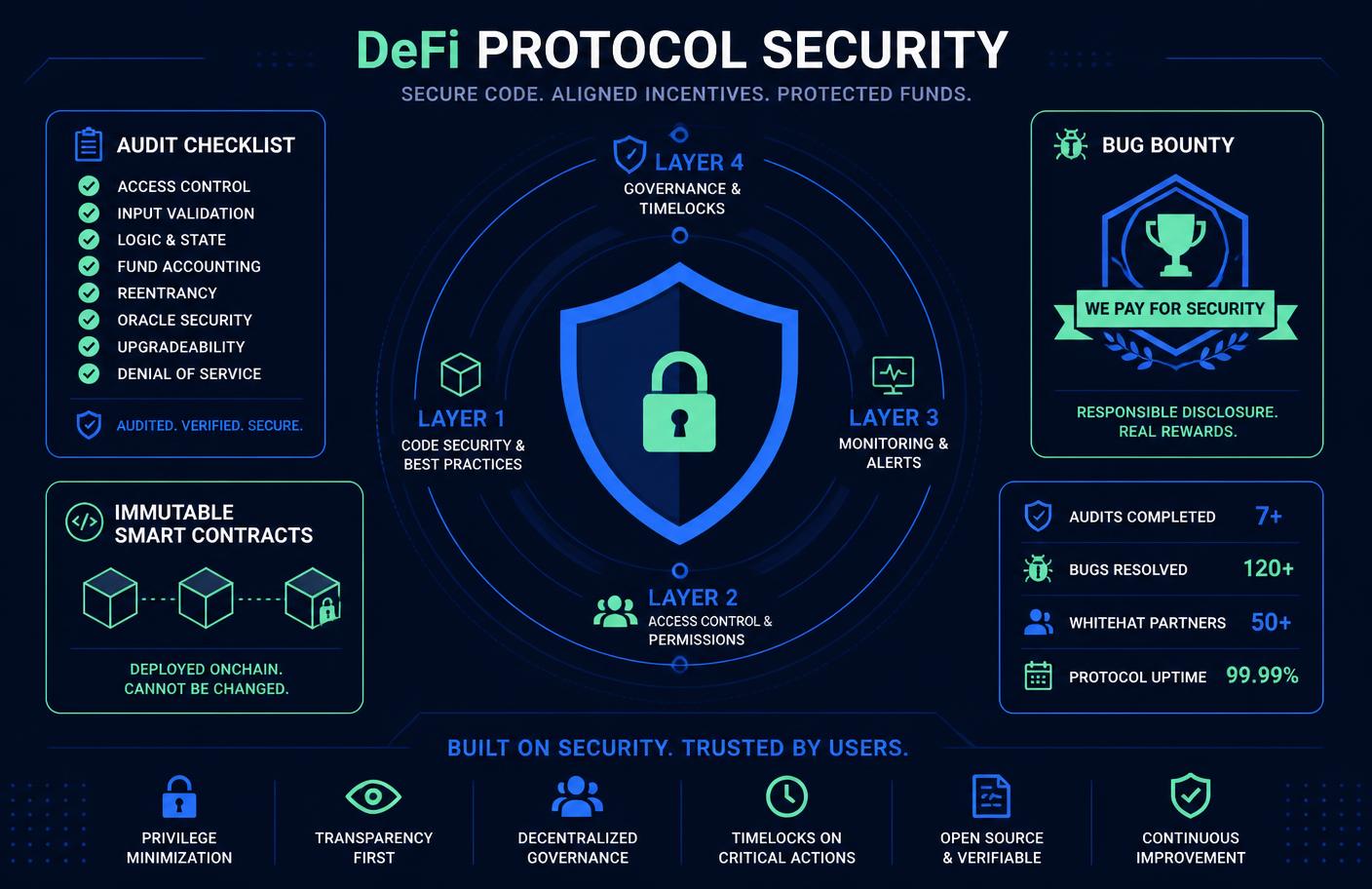
Any serious discussion of Curve Finance has to separate protocol risk from asset risk. Most losses attributed to DeFi exchanges are actually losses caused by the tokens listed on them. Curve Finance sits in the middle of that distinction: the Curve Finance contracts are unusually well tested, while the assets inside Curve Finance pools range from conservative to speculative.
Layer 1: the Curve Finance smart contracts
Curve Finance contracts are written primarily in Vyper, a deliberately restricted language designed to make contracts easier to read and audit than the equivalent Solidity. Core Curve Finance pool contracts have been audited multiple times, run largely immutably once deployed, and have processed an enormous cumulative volume. Immutability cuts both ways: nobody can quietly change the rules of a deployed Curve Finance pool, but nobody can patch it either. The mitigation is that new functionality arrives as new pools rather than as upgrades to existing ones.
History matters here. Curve Finance has experienced incidents originating in compiler-level issues affecting specific contract versions, and the response — coordinated white-hat recovery and disclosure — is part of why the ecosystem treats the protocol as mature. No amount of auditing reduces smart-contract risk to zero, and that should be stated plainly rather than glossed over.
Layer 2: governance and admin powers
Curve Finance governance controls parameters such as fee levels, amplification changes and gauge additions, and those actions pass through the DAO with timelocks. The practical question for a depositor is what a hostile majority could do. In Curve Finance the answer is bounded: governance can adjust parameters and direct emissions, but it cannot arbitrarily seize pool assets. That boundary is a meaningful part of the security story.
Layer 3: oracles and pricing
Stable pools on Curve Finance do not need an external price feed — the curve itself prices the trade. Volatile Curve Finance pools use an internal, manipulation-resistant moving average as their reference. Meanwhile, other protocols read Curve Finance pool state as an oracle, which introduces risk in the opposite direction: a thin Curve Finance pool used as a price source elsewhere can become an attack surface for that other protocol, not for Curve Finance.
Layer 4: the assets themselves
This is where most real losses occur. If a stablecoin in a Curve Finance pool loses its peg, arbitrage will fill the pool with the weak asset and remove the strong ones. Liquidity providers absorb that shift. Before depositing, ask what backs each asset, who can mint it, whether reserves are verifiable, and whether the asset has ever traded meaningfully away from par. A Curve Finance pool is only as sound as its weakest constituent.
Layer 5: the user
- Phishing sites imitating the Curve Finance interface are common — always bookmark.
- Unlimited token approvals left open for years are a standing liability.
- Wallet-drainer signatures often disguise themselves as routine Curve Finance transactions; read what you sign.
- Third-party front ends and vaults built on Curve Finance add their own contract risk on top.
A workable risk framework
Treat every Curve Finance position as the sum of five independent risks: contract, governance, oracle, asset and user error. Score each one before depositing. Most people skip straight to the yield number, which is precisely backwards — the yield is the compensation for the risks, so the risks have to be understood first. Approached that way, Curve Finance remains a strong choice for stablecoin liquidity, with clear-eyed expectations rather than blind confidence.