Curve Finance comparison
Curve Finance vs other DeFi exchanges
Curve Finance is not the only DEX, but for pegged assets it is a different category of product. Here is an honest comparison of Curve Finance against constant-product AMMs, order-book venues and centralized exchanges.
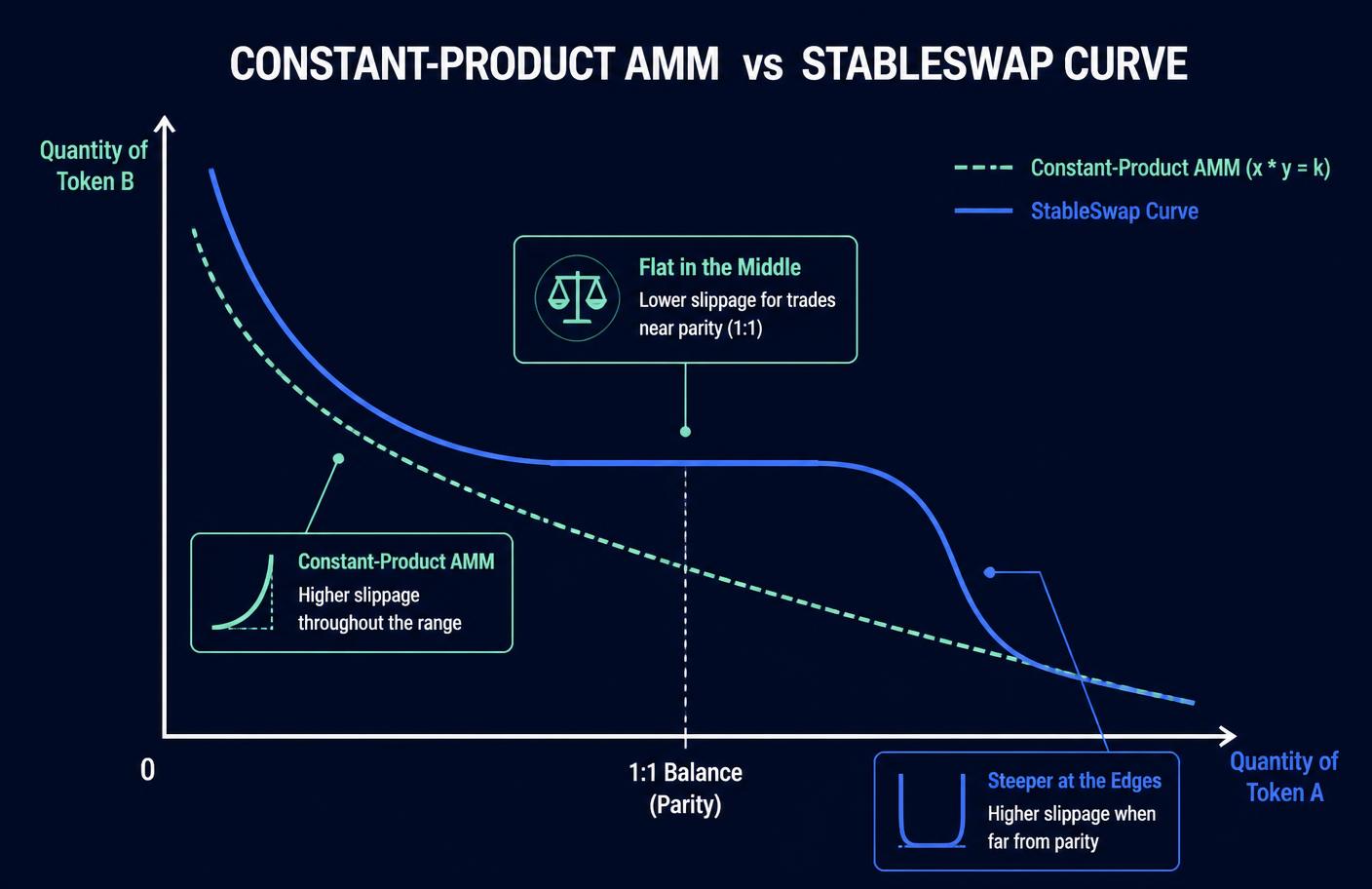
Curve Finance side by side
| Criterion | Curve Finance | Typical alternative DEX |
|---|---|---|
| Pricing model | StableSwap / crypto invariant, flat near parity | Constant product or weighted product |
| Slippage on $1M stable swap | Typically a few basis points | Often tens of basis points or more |
| Capital efficiency for pegged assets | Very high — liquidity sits where trading happens | Low unless positions are manually range-managed |
| Impermanent loss on stable pairs | Negligible while pegs hold | Negligible to moderate, depending on model |
| LP management effort | Passive deposit, no range rebalancing | Concentrated liquidity needs active management |
| Incentive layer | Gauge votes + veCRV boosts | Ad-hoc liquidity mining campaigns |
| Custody | Fully non-custodial | Non-custodial (DEX) or custodial (CEX) |
Curve Finance vs constant-product AMMs
A constant-product exchange is a generalist. It can list any pair instantly and it prices everything with one formula, which is exactly why it is inefficient for dollar-pegged assets. Its liquidity is smeared across every conceivable price, including prices a stablecoin pair will never reach. Curve Finance takes the opposite approach and assumes the two assets belong near each other, then packs liquidity into that narrow band. For a trader the difference shows up immediately in the quote: Curve Finance routinely fills large stable swaps at a fraction of the price impact.
Newer concentrated-liquidity designs close part of that gap, but they push the work onto the liquidity provider, who must pick a range and rebalance when price leaves it. Curve Finance bakes the concentration into the curve itself, so a passive depositor gets the efficiency without managing anything.
Curve Finance vs weighted-pool AMMs
Weighted pools are flexible and useful for index-style exposure, and some offer specialist stable maths of their own. What Curve Finance still brings is the network effect: the deepest pegged-asset pools, the widest aggregator routing and an emissions market that keeps liquidity in place. Depth compounds, and Curve Finance has had the longest head start.
Curve Finance vs order-book venues
On-chain order books can quote tight spreads when professional market makers are present, but they depend on those makers staying online and posting size. Curve Finance liquidity is passive and always there. There is no cancel, no withdrawal of quotes during volatility and no operator that can pause matching. For treasury operations that need certainty of execution, that reliability is often worth more than an occasionally tighter spread.
Curve Finance vs centralized exchanges
A centralized exchange may offer zero-fee stablecoin conversion, but it requires an account, custody of your assets and jurisdiction-dependent access. Curve Finance requires a wallet. Funds never leave your control, the code is public, and the same Curve Finance contract serves everyone identically. The trade-off is that you carry the smart-contract risk yourself and there is no support desk to reverse a mistake.
Where Curve Finance is not the right tool
Curve Finance is deliberately specialised. For a brand-new volatile token with no price history, a constant-product pool is usually the simpler venue. For very small retail swaps on expensive chains, gas can outweigh the Curve Finance slippage advantage. Being honest about those cases is part of understanding why Curve Finance is so strong everywhere else: it optimised hard for one problem instead of trying to be every exchange at once.